Answer Engine Optimization
How brands get cited by ChatGPT, Perplexity, Gemini and Claude — and how to measure and improve AI visibility systematically.
What is Answer Engine Optimization?
Answer Engine Optimization (AEO) is the practice of making your brand more likely to be cited in AI-generated responses from engines like ChatGPT, Perplexity, Gemini and Claude. Where traditional SEO targets the ranked list of blue links on Google, AEO targets the answer itself — the paragraph an AI produces when a user asks a question.
AEO in one sentence: Instead of ranking #1 in a list of links, you want to be the brand an AI mentions first — or mentions at all — when a buyer asks about your category.
The shift matters because AI search behavior is fundamentally different. A user asking Google “best AEO tools” sees 10 links and chooses one. A user asking ChatGPT the same question gets a curated answer — and if you’re not in that answer, you don’t exist for that buyer. There is no page 2.
The discipline goes by several names: AEO (Answer Engine Optimization), GEO (Generative Engine Optimization — coined in a 2023 Princeton paper), LLMO (Large Language Model Optimization), and AI SEO. All describe the same practice. AEO is the most widely adopted industry term.
AEO is complementary to traditional SEO — not a replacement. The content strategies that help AI visibility (authoritative FAQ pages, clear entity definitions, structured schema markup) also benefit Google rankings. But the measurement and optimization loop is entirely separate and requires different tooling.
AEO vs SEO: what’s actually different?
AEO and SEO share the same content foundation — authoritative, well-structured writing — but diverge significantly in what they optimize for, how they’re measured, and how quickly changes take effect.
| Factor | Traditional SEO | AEO |
|---|---|---|
| Target platform | Google, Bing | ChatGPT, Perplexity, Gemini, Claude |
| Success metric | Page rank, organic clicks | Citation presence, citation position |
| Key content signals | Backlinks, keywords, page authority | Entity clarity, FAQ structure, content freshness |
| Measurement tool | Google Search Console, Ahrefs | Surfedo, manual query testing |
| Time to see results | Weeks to months (Google crawl) | Days (Perplexity) to 4–12 weeks (ChatGPT) |
| Result format | Ranked list of 10 links | Single synthesized answer |
| llms.txt relevance | ✗ Google ignores it | ✓ LLMs use it for crawl guidance |
| Schema markup impact | Moderate — rich snippets only | ✓ FAQPage, HowTo, Article strongly preferred |
The most important distinction: in SEO, being in the top 10 still earns traffic. In AEO, if you’re not in the cited brands, you get zero exposure from that query. The competitive dynamics are winner-take-most.
How AI engines decide who to cite
AI engines don’t have a single published ranking algorithm the way Google does. But from testing across thousands of queries, five signal categories consistently drive citation outcomes.
1. Entity clarity and definition
AI engines are fundamentally entity-matching systems. They need to understand what your brand is, what category it belongs to, and what it’s best for — before they can cite it. Brands without a clear entity definition (a concise “X is a Y that does Z” statement, consistently repeated across their own site and third-party sources) are systematically underweighted.
2. Topical authority and content depth
Engines reward brands that have comprehensive, original coverage of their topic area. A brand with 40 high-quality articles covering every facet of their category will outperform a brand with 2 thin pages — even if those 2 pages have stronger backlinks by traditional SEO metrics.
3. Structured schema markup
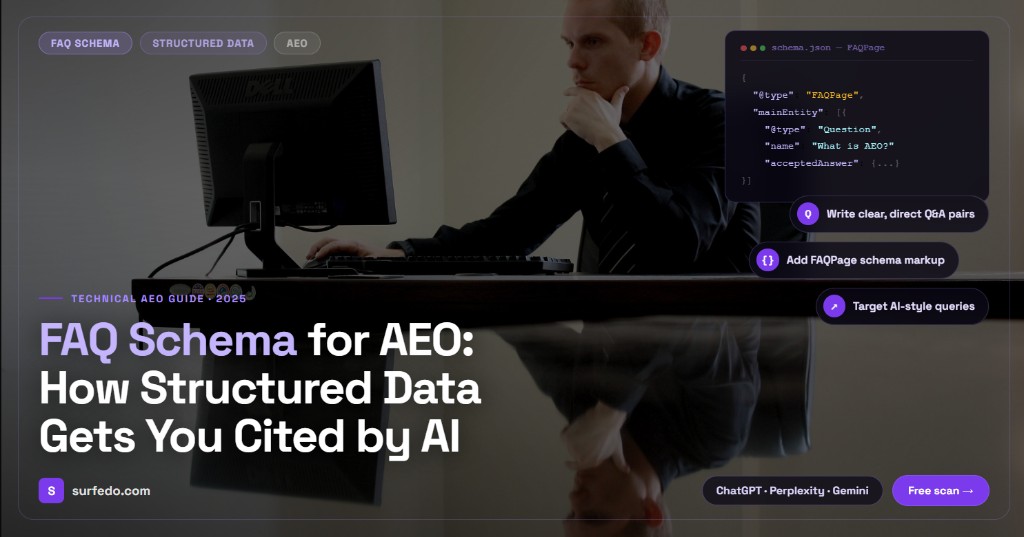
FAQPage, HowTo, Article, and Organization schema give AI systems structured, machine-readable signals about your content’s nature and credibility. Pages with correct schema are significantly more likely to be cited verbatim in FAQ-type and how-to queries.
4. Content freshness
Especially for Perplexity, which uses live retrieval, content published or updated in the past 90 days carries a strong freshness premium. Stale content — particularly pricing, feature lists, or product claims — is a common source of incorrect or missing AI citations. Keeping key pages fresh is an ongoing AEO responsibility.
5. Third-party citation signals
AI engines weight content from high-authority third-party sources: G2, Capterra, Reddit, TrustRadius, and industry publications. If your brand appears frequently and positively in these sources, that signal amplifies your own content’s authority. If you’re only present on your own domain, your entity signal is weak by comparison.
The 7-step AEO framework
This is the sequence Surfedo recommends to brands starting AEO from scratch. Complete each step in order — the later steps build directly on the foundation established in the earlier ones.
Baseline scan — know where you stand
Before changing anything, run a systematic scan across your 20–30 highest-value queries on all five engines. Record your citation position (or absence) for each. This is your baseline. Without it, you cannot tell whether future changes actually moved the needle.
→ Use Surfedo’s scan to generate your baseline in minutesDefine your entity clearly
Write a single clear entity statement for your brand: what it is, who it’s for, and what makes it different. This statement should appear on your homepage hero, your About page, your llms.txt file, and in your Organization schema. Consistency across sources is the key signal AI engines use to resolve your brand’s identity.
Build and publish your llms.txt file
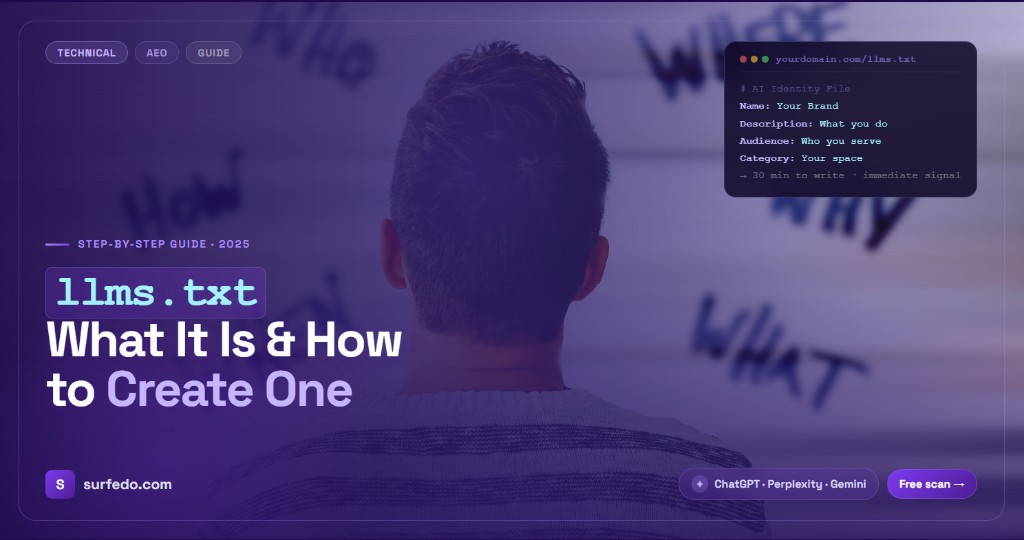
An llms.txt file at your domain root tells AI crawlers what your brand is, what pages matter most, and how to interpret your content. Google ignores it — LLMs use it. It’s the fastest, lowest-effort AEO fix available, and the majority of brands haven’t done it yet.
→ Format: plain text, structured like a READMEPublish a comprehensive FAQ page
AI engines disproportionately cite FAQ content because it directly matches the question format users ask. A FAQ page covering your 20 most common buyer questions — with concise, factual answers — should include FAQPage schema and be linked prominently from your homepage and navigation. This single page often produces the fastest citation gains.
Create comparison content
Queries like “best [category] tools” and “[brand] vs [competitor]” are among the highest-citation queries in any SaaS category. Dedicated comparison pages — written factually, not as attack pieces — consistently appear in AI answers for evaluation-stage queries. Each competitor comparison page is a separate citation opportunity.
Earn third-party citations
Getting your brand mentioned on G2, Capterra, Reddit, TrustRadius, and industry publications amplifies your entity signal beyond your own domain. Request reviews, submit to roundup articles, respond to HARO and Source of Sources queries. Each third-party citation is a vote that reinforces the AI’s belief that your brand is authoritative in your category.
Rescan, diagnose, iterate
Run a fresh scan 4–6 weeks after implementing fixes. Compare your new citation positions against your baseline. Identify which queries improved, which didn’t, and what the next highest-leverage fix is. AEO is a continuous loop — the brands that win are the ones that measure consistently and iterate, not the ones who set it and forget it.
→ Recommended cadence: weekly rescan via SurfedoHow to measure AEO performance
Manual spot-checking — asking ChatGPT a question and seeing if you appear — is not a reliable measurement method. AI responses vary by session, geography, login state, and model version. Accurate AEO measurement requires four things in place simultaneously:
Citation presence
Does your brand appear in the AI’s answer at all? Tracked as binary yes/no across each query and engine. Presence rate across your query set is your headline visibility score.
Citation position
When you appear, are you cited first, second, or fourth? Position 1 in an AI answer drives far more brand recall than position 4. Track position numerically — not just presence.
Competitor gap
Which competitors appear in the same answers as you — or instead of you? Closing the gap against your top competitor is often more actionable than improving your raw score in isolation.
Cross-engine consistency
Your visibility may differ dramatically across ChatGPT, Perplexity, Gemini and Claude. They use different retrieval methods and training data. Track all four independently, not as a single average.
The measurement cadence that works: a baseline scan on day 0, a rescan 4–6 weeks after implementing fixes, then weekly scanning ongoing. Weekly scans catch regressions before they compound and let you tie citation changes to specific content updates you made.
AEO tools: an honest breakdown
The AEO tooling category is young — most tools launched in 2023–2024. Here’s a clear-eyed look at the main options and what they’re actually built for.
Common questions about AEO
SEO targets Google and Bing — the goal is to rank a page in a list of blue links. AEO targets AI answer engines like ChatGPT, Perplexity, Gemini and Claude — the goal is to be cited in the AI-generated answer itself. They share the same content foundation but require different signals, different measurement, and different fix strategies. AEO is complementary to SEO, not a replacement.
The five engines that matter most for brand visibility are ChatGPT (OpenAI), Perplexity, Gemini (Google), and Claude (Anthropic). Each uses slightly different retrieval and ranking signals. A complete AEO strategy tracks and optimizes for all four — citation presence varies significantly across engines for the same query.
Ask each of the five AI engines: “What are the best [your product category] tools?” If you don’t appear, or if competitors consistently appear before you, you have an AEO gap. A systematic scan using Surfedo gives you this data across all tracked queries and engines automatically, with position rankings rather than just mention detection.
No. The content strategies that help AEO — FAQ pages, structured schema, clear entity definitions, high-quality comparison content — are also good for Google SEO. They are fully complementary. The only AEO-specific element that is neutral for Google is llms.txt, which Google ignores but LLMs actively use. See our full breakdown: GEO vs AEO vs SEO: What's the Difference?
Perplexity, which uses live retrieval, can reflect new content within days. ChatGPT and Gemini typically take 4–12 weeks to reflect changes. Entity definition updates tend to have the fastest impact. Content freshness fixes typically show results within 2–6 weeks on retrieval-based engines.
The highest-performing AEO content types are: FAQ pages that answer specific buyer questions directly; comparison pages (X vs Y) that AI engines cite for evaluation queries; definitional content (“what is X?”); how-to guides with numbered steps; and case studies with specific outcomes. All should include the relevant schema markup — FAQPage, HowTo, or Article.
AEO and GEO describe the same underlying practice — optimizing for AI-generated answers rather than ranked links. GEO was coined by researchers at Princeton in a 2023 paper. AEO is the more widely adopted industry term. You may also encounter LLMO (Large Language Model Optimization) or AI SEO. All refer to the same discipline.
Accurate AEO tracking requires: a consistent set of queries tracked across all five engines, systematic rescanning at a regular cadence (weekly is recommended), position extraction — not just mention detection — and before-and-after data tied to specific fixes. Manual spot-checking is not reliable because AI responses vary by session, geography, and model version. Full guide: How to Measure AI Visibility: The Metrics That Actually Matter
Find out where AI ranks your brand today
Run a free scan across ChatGPT, Perplexity, Gemini and Claude. See exactly where you appear — and where competitors are beating you.
Scan My Brand Free