The B2B SaaS AI Visibility Playbook:
8 Weeks to AI Recommendation Presence
Most B2B SaaS brands have zero structured AI presence. This playbook takes you from zero to systematically appearing in ChatGPT, Perplexity, Gemini, and Claude recommendations — week by week, action by action.
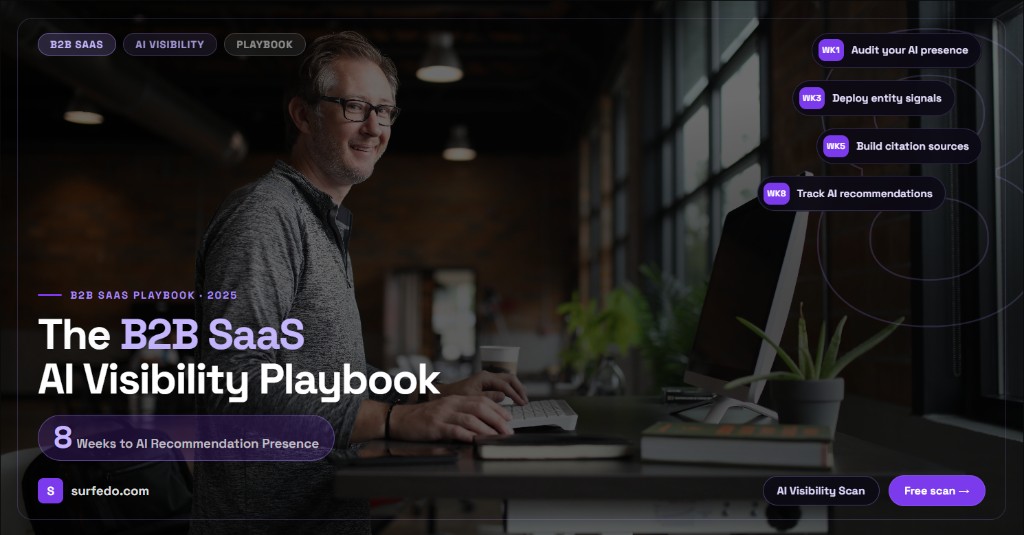
This 8-week playbook covers the four pillars of B2B AI visibility: entity authority (weeks 1-2), technical infrastructure (weeks 3-4), content signals (weeks 5-6), and off-site presence (weeks 7-8). Each week has a specific output you can ship. By week 8, you'll have a measurable AI visibility baseline and a repeatable improvement loop.
Why most B2B SaaS brands are invisible to AI engines
When a B2B buyer asks ChatGPT "what's the best tool for [your category]," the AI doesn't search the web in real time (unless you're using Perplexity or a browsing-enabled model). It draws on its training data and knowledge base to construct an answer. If your brand isn't in that knowledge base with sufficient depth and consistency, it doesn't appear — regardless of your domain authority, content volume, or marketing budget.
The brands that dominate AI recommendations today aren't necessarily the biggest or best-funded. They're the ones that understood, early, how AI knowledge bases are built and what signals they weight. They have Wikidata entries. They have consistent entity descriptions. They have G2 review presence. They have FAQ schema. They allow AI crawlers. They've done the specific work that AI recommendation requires — not just the SEO work that Google ranking requires.
This playbook is the complete sequence of that work.
Before any playbook work, run a baseline measurement. Query 5-10 AI engines with your most important commercial prompts ("best [your category] tool," "top [your category] software for [your ICP]") and record whether you appear and at what position. Without a baseline, you can't measure progress. Use Surfedo's free scan to get your starting numbers in about 2 minutes.
Week 1–2: Entity Authority Foundation
Week 1: Wikidata entry
Your first action is to create a Wikidata entry for your brand. Wikidata is the open structured knowledge base that AI language models actively read. An entry gives you a unique entity identifier (Q-number) and structured properties that AI can read directly.
What to include in your Wikidata entry: instance of (Q-5166128: software company or Q-7397: software), official name, founding date, country, official website URL, industry classification, and key personnel. The more properties you fill in, the more structured signal you're providing.
Creating a Wikidata entry takes 45-60 minutes. Visit wikidata.org, create an account, and follow the "Create a new item" flow. There are no notability requirements for organisations — any legitimate company can create an entry.
Week 2: Entity description standardisation
AI engines build their understanding of your brand by aggregating descriptions from dozens of sources. When those descriptions are inconsistent — "AI SEO tool" on one platform, "ChatGPT ranking tracker" on another, "marketing analytics platform" on a third — the AI gets a blurry, ambiguous picture. Blurry entities get lower confidence recommendations.
Write one canonical brand description (one sentence, under 25 words) and update every touchpoint: homepage meta description, G2 company description, Capterra profile, LinkedIn company page, Crunchbase, AngelList/Wellfound, Product Hunt, Twitter/X bio, and any press bylines you control. The Surfedo canonical description is: "Surfedo is the AI search visibility platform that tracks exact brand rankings on ChatGPT, Perplexity, Gemini, and Claude and generates the fixes to improve them."
Week 3–4: Technical Infrastructure
Week 3: AI crawler access audit + llms.txt
Many brands are inadvertently blocking AI crawlers in their robots.txt — often through legacy rules that block all unlisted bots. Check your robots.txt right now for GPTBot, PerplexityBot, ClaudeBot, and GoogleOther. If they're blocked or not explicitly allowed, fix that immediately. A crawler that can't read your site cannot cite it. No technical, content, or entity work matters if the crawler can't get in.
Then create your llms.txt file at your domain root. This is a plain-text file that tells AI models exactly how to understand and describe you. It should include: a one-sentence description, what you do and for whom, your key features, pricing (Pro $79/mo, Agency $199/mo for Surfedo), and a list of your canonical page URLs. Full llms.txt guide at /blog/llms-txt-guide.
Week 4: Schema markup sprint
Add structured data to your four highest-traffic pages this week. Priority order: homepage (Organization + SoftwareApplication + FAQPage), pricing page (FAQPage + SoftwareApplication offers), top comparison page (FAQPage + BreadcrumbList), and your main product feature page (SoftwareApplication + FAQPage).
For each FAQ schema item: match the exact language buyers use in AI queries, lead with the direct answer, include your brand name explicitly, keep answers under 150 words, and include specific numbers where possible. Vague answers get ignored; specific ones get cited verbatim.
| Week | Output | AI Signal Type | Time Required |
|---|---|---|---|
| 1 | Wikidata entry created | Entity authority | 1 hour |
| 2 | Brand description standardised across 8+ platforms | Entity consistency | 2-3 hours |
| 3 | robots.txt fixed + llms.txt live | Crawler access + brand signal | 2 hours |
| 4 | Schema on 4 key pages | Structured data | 4-6 hours |
| 5 | 4 query-targeted blog posts | Content footprint | 8-12 hours |
| 6 | Comparison pages (top 3 competitors) | Commercial query coverage | 6-8 hours |
| 7 | G2 review campaign launched | Third-party review signals | 2-3 hours setup |
| 8 | Reddit + community presence seeded | Forum citation signals | Ongoing |
Week 5–6: Content Signal Sprint
Week 5: Query-targeted blog content
Publish four blog posts this week, each targeting a specific query your buyers type into AI engines. The format: question as the H1, direct answer in the first 2-3 sentences, then a structured expansion with headers, a comparison table or numbered list, and FAQ schema on the page.
Four high-value query types for B2B SaaS: (1) "What is [your category]" — the definition post, (2) "How to [achieve the outcome you enable]" — the how-to post, (3) "Best [your category] tools" — the category roundup (include yourself objectively), (4) "Is [your product] worth it" — the transparent evaluation post. Each targets a different part of the AI recommendation funnel.
For each post: add FAQPage schema with 4-5 questions matching common buyer queries. Use your brand name in answer text — AI engines extract and recite these answers verbatim, so make sure your name is in them. Keep FAQ answers under 150 words each.
Week 6: Competitor comparison pages
Comparison queries ("X vs Y", "alternatives to X") are among the most commercially important AI queries. A buyer asking "Surfedo vs Profound" is very close to a decision. If Surfedo doesn't have a dedicated comparison page, the AI pulls from wherever it can find comparative information — which might be a competitor's blog, a biased Reddit thread, or nothing at all.
Create dedicated comparison pages for your top three competitors. Each page should: use a structured feature comparison table, be factually accurate about both products (AI engines value honest comparisons and will cite them more frequently), include FAQPage schema, and target both "[your brand] vs [competitor]" and "[competitor] alternatives" in its title and headings.
Week 7–8: Off-Site Presence
Week 7: Review platform sprint
G2, Capterra, and Trustpilot are among the most-cited sources by AI engines for B2B SaaS recommendations. AI engines weight these heavily because they aggregate independent user voice — which AI models treat as higher-trust than brand-owned content. A brand with 50 specific G2 reviews is recommended more confidently than a brand with no reviews and a beautiful website.
This week: identify your top 10 satisfied customers, email them a personal review request with a direct link to your G2 page. Brief them on what makes a useful review: include the specific use case, the outcome they achieved, and — ideally — a mention of specific features. Generic reviews ("great tool, very helpful") provide less AI citation signal than specific ones ("We use Surfedo to track our ChatGPT rankings weekly — went from #4 to #1 for 'AI visibility platform' in 6 weeks").
Week 8: Reddit and community seeding
Reddit is disproportionately cited by ChatGPT and Perplexity. A genuine, helpful Reddit post or comment about your product — in a relevant subreddit, answering a real question — can appear in AI responses for months. The key word is genuine: Reddit communities are quick to flag promotional content, and AI engines can distinguish authentic discussion from astroturfing.
This week: identify 3-5 subreddits relevant to your category. Answer five existing questions where your product is the legitimate best answer. Don't just name-drop — explain why it's the right answer for the person's specific situation. Then create one original post (a guide, a case study, or a genuine question for the community) that naturally establishes your expertise in the space.
Beyond Reddit: answer questions on Quora and Stack Overflow in your category. Each platform adds to your AI citation footprint and reduces over-dependence on any single source.
The ongoing loop: measure, fix, verify
After week 8, you have the foundation. Now the work becomes a weekly loop: measure your AI rankings, identify the lowest-performing queries, make a targeted fix (new content, schema update, review campaign), and verify the impact 7-14 days later.
This compounding loop is where the real advantage builds. Early movers who establish this loop now will have 6-12 months of position data and a tested playbook by the time competitors start paying attention to AI visibility. The brands that dominate AI recommendations in 2026 are building those signals today.
AI visibility improvements compound in a way SEO doesn't. A Wikipedia entry doesn't decay. Wikidata properties persist. G2 reviews accumulate. Entity consistency strengthens over time. The work you do in weeks 1-2 still helps you in year 2. Unlike paid acquisition, AI visibility has near-zero marginal cost at scale — you're building an asset, not renting attention.
What to prioritise if you have limited time
If you can only do three things this week, do these: (1) Create your Wikidata entry — 1 hour, permanent entity signal, almost nobody does it. (2) Fix your robots.txt to explicitly allow GPTBot, PerplexityBot, and ClaudeBot — 10 minutes, prerequisite for all other work. (3) Add FAQPage schema to your homepage and pricing page — 2 hours, direct structured signal to AI engines for your most important queries.
These three actions take under 4 hours and cover the entity, crawler access, and structured data pillars simultaneously. They won't deliver overnight results — AI rankings typically take 4-8 weeks to move — but they're the highest-ROI starting point available to any B2B SaaS brand.
Surfedo tracks exact position rankings across ChatGPT, Perplexity, Gemini, Claude, and Google AI Overviews — so you can measure the impact of every playbook action. Free scan to start.