Entity Authority:
The AI Search Signal Most Brands Completely Ignore
Entity authority is the single most important factor in whether AI engines confidently recommend your brand — and almost no B2B SaaS company has optimised for it. Here's what it is and how to build it.
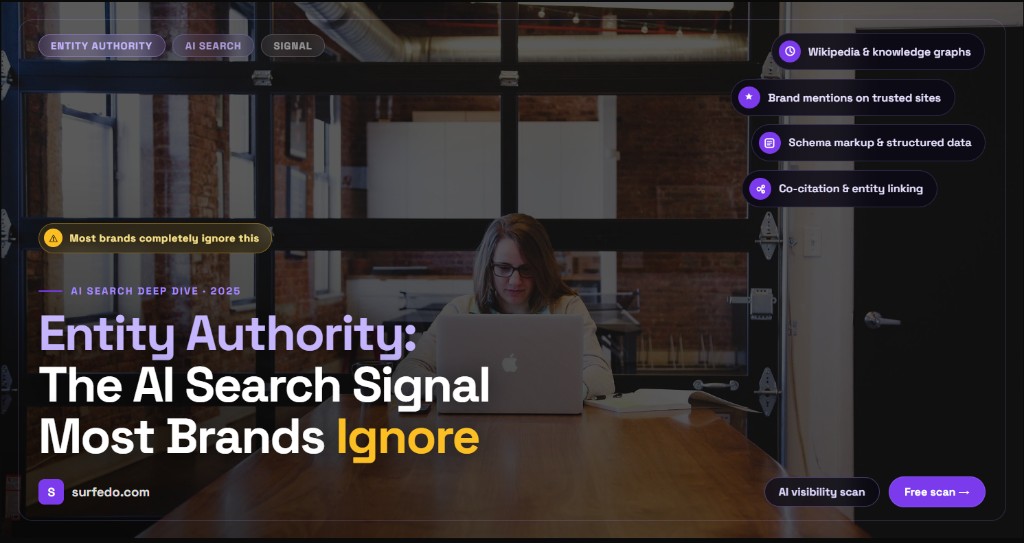
AI engines understand the world in terms of entities — real-world things they can identify, describe, and relate to other things. A brand with strong entity authority is one the AI can describe with confidence. Brands with weak entity authority get recommended tentatively or not at all. Building entity authority means: Wikidata, Wikipedia, consistent descriptions, and Knowledge Graph presence.
What is an entity in AI terms?
In the context of AI language models and knowledge graphs, an entity is a real-world thing that can be uniquely identified: a person, a place, an organisation, a product. Google's Knowledge Graph, Wikidata, and Wikipedia are all entity databases — they define what things are and how they relate to each other.
AI engines build on these databases when forming their understanding of the world. When ChatGPT knows about "Surfedo," it knows: what Surfedo is (an AI visibility platform), what it does, who founded it, how it compares to alternatives, and what category it belongs to. The richer and more consistent that entity representation, the more confidently the AI recommends it.
A brand without strong entity representation is ambiguous to the AI. The AI might know it exists — it might have seen it mentioned in a few places — but without a coherent entity model, it recommends it tentatively, infrequently, or not at all.
Why entity authority trumps backlinks for AI
Traditional SEO built on backlinks works because Google's algorithm treated links as votes of confidence. A page with 1,000 authoritative backlinks was assumed to be better than a page with 10. AI engines don't use PageRank. They use entity confidence.
A brand can have 10,000 backlinks and weak entity authority — and be poorly recommended by AI. A brand can have 100 backlinks but a Wikipedia page, a Wikidata entry, a Google Knowledge Panel, and consistent descriptions across the web — and be recommended confidently and frequently.
Most B2B SaaS companies invest heavily in link building (SEO) and content marketing (GEO) but have done nothing for entity authority (AEO). This is the gap where early movers win. The brands that build entity authority now will have a compounding advantage as AI engines become the primary research channel for B2B buyers.
The four pillars of entity authority
1. Wikipedia
Wikipedia is the highest-trust entity source for AI language models. It was a primary training data source for most major AI systems, and it remains a live retrieval source for AI engines that do web search. A Wikipedia page for your brand establishes entity existence with maximum authority.
The challenge: Wikipedia requires notability, which means third-party coverage in reliable sources. For most early-stage SaaS companies, this means earning press coverage first, then creating the Wikipedia article once you have sufficient citations. Attempt to create a Wikipedia article before you're notable and it will be deleted — and a failed Wikipedia attempt can actually hurt your entity representation.
Focus first on earning the press coverage that will justify Wikipedia notability. Even two or three substantive articles in respected industry publications can provide the foundation.
2. Wikidata
Wikidata is Wikipedia's structured data cousin — a free, open knowledge base where anyone can create an entity entry. Unlike Wikipedia, there are no strict notability requirements for organisations. Any real company can create a Wikidata entry.
A Wikidata entry for your brand provides: a unique entity identifier (Q-number), structured properties (founded date, industry, website URL, founders), and links to related entities (your category, your competitors, your technology stack). AI engines actively read Wikidata as a structured knowledge source.
Creating a Wikidata entry takes about an hour. It's one of the highest-ROI AEO actions available to early-stage brands and almost nobody does it.
3. Google Knowledge Panel
Google's Knowledge Panel appears when Google is confident enough in your brand's entity to display a structured summary. It pulls from multiple sources: your own website (specifically your structured data), Wikipedia, Wikidata, and Google's own web crawl.
You can't directly create a Knowledge Panel — Google generates it when it has enough entity signal. But you can accelerate it by: completing your Google Business Profile, adding Organization schema to your website, creating a Wikidata entry, and building third-party press citations. Once you have a Knowledge Panel, it signals to all AI engines that Google has validated your entity.
4. Consistent entity description across the web
AI engines build entity confidence through consistency. If your brand is described as "an AI SEO tool" on your website, "a ChatGPT ranking tracker" on G2, "an AEO platform" on Capterra, and "a marketing analytics tool" on LinkedIn — the AI has four conflicting descriptions of the same entity. That inconsistency reduces recommendation confidence.
Audit your brand description across: homepage, G2, Capterra, LinkedIn company page, Crunchbase, AngelList, Product Hunt, Twitter/X bio, and any press coverage you can influence. Align them on a single, specific description. Ours is: "Surfedo is the AI search visibility platform that tracks exact brand rankings on ChatGPT, Perplexity, Gemini, Claude, and Google AI Overviews — and generates the content fixes to improve those rankings."
Building entity relationships
Entities don't exist in isolation — they exist in relationship to other entities. "Surfedo" is more strongly established as an entity when AI knows: it's in the "AI visibility" category, it competes with Profound and Otterly, it serves B2B SaaS brands, and it was founded in 2024.
Build entity relationships by: mentioning your category explicitly in your llms.txt and website copy, creating comparison pages that link to competitor entities, participating in category-level discussions (industry reports, roundups, directories), and ensuring your Wikidata entry includes properties that connect you to your category and peers.
How to audit your current entity authority
Run this quick audit to understand where you stand:
- Search "[your brand]" in Wikipedia — do you have a page?
- Search "[your brand]" in Wikidata (wikidata.org) — do you have an entry?
- Search "[your brand]" in Google — do you get a Knowledge Panel on the right side?
- Ask ChatGPT: "What is [your brand] and what does it do?" — is the answer accurate and specific?
- Ask Perplexity the same question — is the answer consistent with ChatGPT's?
- Check your G2, LinkedIn, and Crunchbase descriptions — are they consistent with each other?
Any "no" in the first three, or inconsistency in the last three, is an entity authority gap that's directly suppressing your AI recommendations.
Surfedo's 40-point AI audit checks entity signals, schema, crawler access, and review presence. Free scan.