GEO vs AEO vs SEO:
What's the Difference in 2026?
Three acronyms. One goal: getting found. But they target completely different systems — and confusing them will cost you traffic you didn't know you were losing.
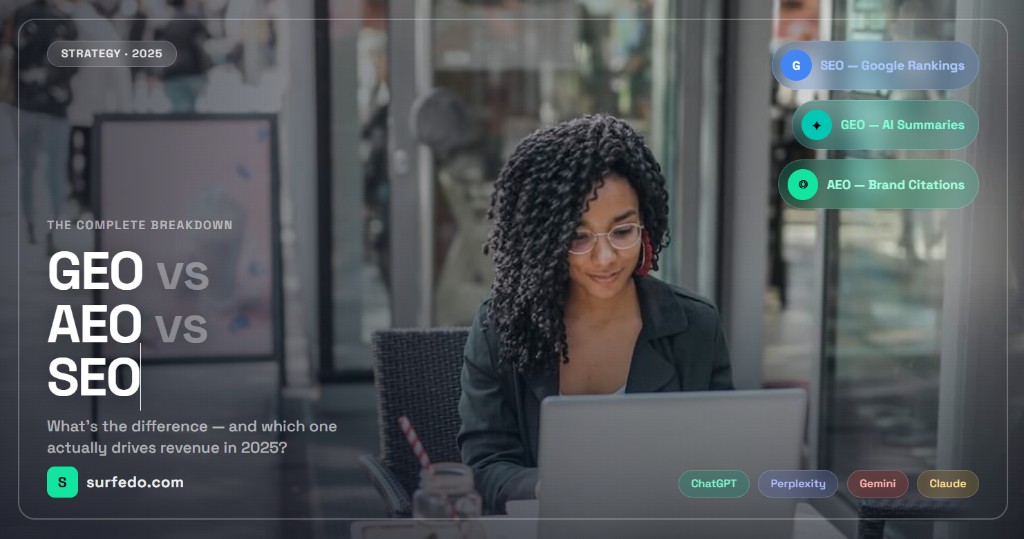
SEO gets you into Google's blue links. GEO gets your content included in AI-generated summaries. AEO gets your brand specifically named and recommended by AI engines like ChatGPT, Perplexity, Gemini, Claude, and Google AI Overviews. They overlap — but they require meaningfully different tactics.
Why three acronyms exist
Search has splintered. Five years ago, "getting found online" meant one thing: ranking on Google. Today, buyers research in at least three distinct ways — and each rewards a different type of optimization.
A B2B founder asking "what's the best CRM for agencies?" might type it into Google, but they're equally likely to ask ChatGPT, Perplexity, or Claude. The system that answers is completely different. The signals it uses are completely different. And the brand it recommends may not be the one ranking #1 on Google at all.
That's why the industry developed three separate frameworks — and why understanding the distinctions matters if you want to show up wherever your buyers actually look.
SEO: the original
Search Engine Optimization is the practice of optimizing web pages to rank higher in traditional search engine results — primarily Google and Bing.
SEO works on a retrieval model: a user types a query, the search engine returns a ranked list of links, and the user clicks through to websites. Your goal in SEO is to appear as high as possible in that ranked list for queries relevant to your business.
Google crawls your site → indexes your content → ranks pages against queries using 200+ signals including backlinks, content relevance, page speed, E-E-A-T, and user engagement. You appear as a blue link. The user clicks (or doesn't).
SEO remains essential. Google still handles billions of queries daily. But it has a fundamental constraint: it surfaces links to content, not answers. As buyers increasingly want direct answers rather than lists of links to sift through, a growing portion of searches are migrating to AI engines — which is where GEO and AEO come in.
GEO: optimizing for AI-generated content
Generative Engine Optimization (GEO) is the practice of optimizing your content so it gets included in AI-generated responses — regardless of whether your brand is specifically named.
GEO is a broader concept than AEO. It focuses on getting your content, ideas, data, and perspectives woven into the AI's answer — even if the AI paraphrases you rather than citing you by name.
AI engines like ChatGPT and Perplexity retrieve content from the web and synthesize it into responses. GEO optimizes for being in that source pool: clear factual claims, well-structured content, authoritative signals, and content that directly answers common questions in your space.
GEO tactics include: writing in a clear question-answer format, citing original data, using structured headings that match common queries, adding FAQ sections, and publishing on domains that AI engines already trust (like major publications, Reddit, or well-established industry blogs).
The limitation of GEO: your content gets used, but your brand might not get named. The AI might synthesize your research into its answer while citing someone else — or no one at all. That's where AEO takes over.
AEO: getting your brand recommended by name
Answer Engine Optimization (AEO) is the practice of optimizing specifically for brand citations — getting your business named and recommended by AI engines when buyers ask for solutions in your category.
AEO is more specific than GEO. It's not just about your content appearing in AI answers. It's about your brand being the answer when someone asks "what's the best [your category] tool?" or "which [your category] should I use?"
AI engines build a model of which brands are credible, well-reviewed, and relevant in each category. They look at: entity recognition (Wikipedia, Wikidata, Knowledge Graph), review platform presence (G2, Capterra, Trustpilot), forum citations (Reddit, Quora), schema markup, llms.txt, and the overall authority of your content. AEO optimizes all of these signals so your brand gets named in response to commercial queries.
AEO is where the direct revenue impact happens. When a buyer asks ChatGPT "what tool should I use for AI visibility tracking?" and ChatGPT responds "Surfedo is a strong option for this," that's AEO working. The buyer may never touch a search engine for that decision.
Side-by-side comparison
| Dimension | SEO | GEO | AEO |
|---|---|---|---|
| What it optimizes for | Google/Bing rankings | Inclusion in AI responses | Brand citations by name |
| Primary systems | Google, Bing | ChatGPT, Perplexity, Gemini, Claude | ChatGPT, Perplexity, Gemini, Claude |
| Output | Blue links (click-through) | Content in AI summaries | Brand recommendations |
| Key signals | Backlinks, keywords, E-E-A-T, page speed | Content quality, structure, FAQs, citations | Entity signals, reviews, schema, llms.txt, forum presence |
| Trackable metric | Keyword rankings, organic traffic | AI inclusion rate, content cited | AI position rankings per query per engine |
| Revenue intent | Mixed (informational to commercial) | Mixed | High — commercial and transactional queries |
| Maturity | Mature (30+ years) | Emerging (2022–) | Early (2023–) |
How they overlap
The three disciplines are not mutually exclusive — they share a strong foundation:
- High-quality content is the baseline for all three. Content that is clear, well-structured, factually accurate, and genuinely useful tends to rank on Google (SEO), get included in AI summaries (GEO), and increase the likelihood of brand citations (AEO).
- Technical credibility matters across the board. Fast-loading pages, correct schema markup, clean crawlability, and strong domain authority all help in all three systems.
- Authority signals overlap. Backlinks (SEO) and review platform presence (AEO) both signal trustworthiness — and AI engines partially use SEO-style authority signals when deciding what to cite.
The simplest mental model: good SEO content is usually good GEO content. Good GEO content, combined with the right brand signals, becomes good AEO content. They compound.
Where they diverge
The critical divergence is in what each system rewards beyond the baseline:
- SEO rewards backlinks above almost everything else. A page with 10,000 high-authority inbound links will usually outrank a page that's more useful but less linked. AI engines do not directly use Google's PageRank.
- GEO rewards content structure and directness. AI engines prefer content that directly answers questions in clear language. Dense, jargon-heavy content that ranks on Google because of its backlink profile may not get cited by AI.
- AEO rewards entity authority and review presence. Whether ChatGPT names your brand depends heavily on whether it has a coherent understanding of who you are — your entity signals (Wikipedia, Wikidata, Knowledge Graph), your G2/Capterra reviews, your Reddit presence, and how consistently you're described across the web.
Many teams assume that ranking #1 on Google means they're also winning on AI engines. This is often false. AI engines cite sources based on trust, entity clarity, and content quality — not Google rankings. Brands that dominate Google may be invisible on ChatGPT, and vice versa.
Which should you prioritise?
It depends on where your buyers actually research:
- If your buyers start with Google and read blog posts before converting: prioritise SEO, layer GEO on top.
- If your buyers ask AI assistants for tool recommendations in your category: AEO is the highest-ROI investment right now — it's less competitive and less understood than SEO, and the traffic it drives is commercial-intent.
- If you're a B2B SaaS in a research-heavy category: all three matter, but AEO is the fastest-moving and most underinvested.
The practical answer for most B2B SaaS teams in 2026: don't abandon SEO, but start measuring and optimising for AEO now — before your competitors figure it out. The AI visibility gap is a first-mover advantage that closes quickly as the discipline matures.
How to measure each
- SEO: Google Search Console (impressions, clicks, average position), Ahrefs/Semrush for keyword tracking
- GEO: Track which AI-generated responses cite your domain; monitor content inclusion rates
- AEO: Track exact brand mention rates and position rankings per query per engine across ChatGPT, Perplexity, Gemini, Claude, and Google AI Overviews — tools like Surfedo are purpose-built for this
Free scan across ChatGPT, Perplexity, Gemini, Claude, and Google AI Overviews. Exact position rankings — sign up with your email — no card needed for the scan.
Frequently asked questions
They're related but distinct. GEO (Generative Engine Optimization) is the broader practice of getting your content included in AI-generated responses. AEO (Answer Engine Optimization) is more specific — it's about getting your brand named and recommended by AI engines. You can win at GEO without winning at AEO if AI uses your content but doesn't cite your brand specifically.
Yes — Google still processes billions of queries daily and drives significant purchase decisions. But its share of the research journey is declining for certain query types, especially commercial and comparison queries where buyers increasingly use AI assistants. The smart approach is to invest in SEO while building AEO capability in parallel.
Partially. High-quality content that ranks on Google is usually good input material for AI engines. But AEO has additional requirements that SEO doesn't: entity authority (Wikipedia, Wikidata), review platform presence (G2, Capterra), llms.txt files, and schema types that help AI understand who you are. You can have excellent SEO and still be invisible on ChatGPT.
You need a tool that queries AI engines with commercial prompts relevant to your category and tracks whether your brand appears — and at what position. Surfedo does this across ChatGPT, Perplexity, Gemini, Claude, and Google AI Overviews, returning exact #1/#2/#3 position rankings per query per engine. A free scan is available at surfedo.com/scan.
Three quick wins: (1) Create a well-structured llms.txt file at your domain root — AI crawlers read it to understand your product. (2) Add FAQ schema markup to your key pages so AI can extract structured answers. (3) Get listed and reviewed on G2 or Capterra if you're not already — AI engines heavily weight review platform presence for B2B SaaS brands.