How to Get Cited by ChatGPT:
7 Tactics That Actually Work
ChatGPT is recommending your competitors to buyers in your category right now. Here's exactly how to get it recommending you instead — with tactics that work across all four major AI engines.
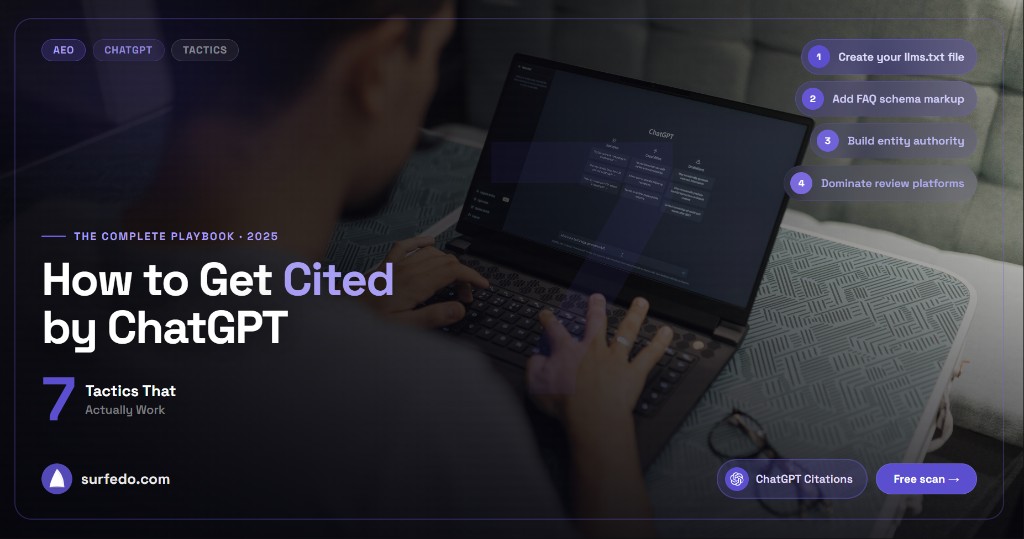
Getting cited by ChatGPT isn't luck — it's a system. The seven tactics below cover the full stack: content structure, technical signals, entity authority, review presence, and the one file most brands have never heard of. Together they shift you from invisible to recommended.
Why ChatGPT recommends some brands and not others
ChatGPT doesn't have a simple ranking algorithm you can game. It builds an understanding of the world from its training data and live retrieval — and it recommends brands it has high confidence in based on: how clearly you're described across the web, how many trusted third-party sources mention you, what review sites say about you, and whether your own content is structured in a way AI can parse.
Most brands are invisible on ChatGPT not because they're bad products — but because they've optimised entirely for Google and never thought about what signals AI engines use. The gap between "ranking on Google" and "recommended by ChatGPT" is real, and it's still wide enough to be a first-mover advantage.
Here are the seven tactics that close that gap.
Tactic 1: Create and optimise your llms.txt file
The llms.txt file is a plain-text file at your domain root (e.g. yourdomain.com/llms.txt) that tells AI models exactly who you are, what you do, who you serve, and how to describe you. Think of it as a robots.txt — but for AI models instead of crawlers.
A well-written llms.txt includes: your product definition in one clear sentence, your key features in bullet form, pricing, your target audience, and how you compare to alternatives. It helps AI agents and orchestration tools understand your brand. It does not directly drive ChatGPT or Perplexity citation rankings — for those, see entity authority, schema, and review signals in the tactics below.
# Surfedo — AI Visibility & AEO Platform
Surfedo tracks exact brand position rankings (#1, #2, #3) across ChatGPT, Perplexity, Gemini, Claude, and Google AI Overviews — and generates the fix content to improve those rankings. Unlike monitoring tools, Surfedo closes the full loop: track, fix, verify.
Most brands don't have one. Write yours today. It takes 30 minutes and the signal is immediate for AI engines that actively crawl it.
Tactic 2: Add FAQ schema markup to every key page
FAQ schema (JSON-LD type FAQPage) is one of the most direct ways to feed AI engines structured, citable content. When you mark up a page with FAQ schema, you're explicitly telling AI crawlers: "here are questions buyers ask, and here are our answers." That's exactly the format AI engines want to cite.
Add FAQ schema to: your homepage, your pricing page, your comparison pages, and your product feature pages. Each FAQ item should answer a real question your buyer types into ChatGPT — not marketing copy. Keep answers factual, specific, and under 150 words.
If you're not sure which questions to write schema for, query ChatGPT with your category (e.g. "what should I look for in an AI visibility tool?") and write schema that answers those exact questions.
Tactic 3: Build entity authority across the web
ChatGPT understands brands as entities — and it only recommends brands it has a coherent, consistent understanding of. Entity authority comes from: how you're described on Wikipedia, whether you appear in Google's Knowledge Graph, your Wikidata entry, and consistent NAP (name, address, phone) signals across the web.
For most B2B SaaS brands, the most impactful entity actions are:
- Create a detailed, well-sourced Wikipedia article if you qualify (product must be notable)
- Claim and complete your Wikidata entry (this is free and open to any brand)
- Ensure your brand description is identical across your website, LinkedIn, G2, Capterra, Crunchbase, and AngelList
- Get your brand mentioned in industry publications (even small ones) to build citation breadth
Tactic 4: Dominate review platforms
G2, Capterra, and Trustpilot are among the most-cited sources by AI engines for B2B SaaS recommendations. When ChatGPT is asked "what's the best tool for X?", it heavily weights what review platforms say — because review platforms aggregate signal from many independent users, which AI engines treat as higher-trust than the brand's own website.
Prioritise: G2 (most cited for SaaS), Capterra, and any category-specific review aggregator. Aim for at least 25 reviews before expecting meaningful AI citation lift. Ask customers to include specific use cases and outcomes in their reviews — AI engines extract that content and use it to describe your product.
Brands collect 5-star ratings but neglect the written content of reviews. AI engines don't just see your star rating — they read the review text and use it to understand what your product does and who it's for. A review that says "great tool!" helps nobody. A review that says "Surfedo showed us we were ranked #4 on Perplexity for our main query and we fixed it in a week" is the kind of content that gets you cited.
Tactic 5: Establish a strong Reddit presence
Reddit is disproportionately cited by ChatGPT and Perplexity for B2B software questions. When buyers ask AI engines for tool recommendations, the AI frequently pulls from Reddit discussions — because Reddit represents real user opinions rather than brand marketing.
Tactics that work: participate authentically in relevant subreddits (r/SaaS, r/marketing, r/SEO, and category-specific ones), answer questions where your product is genuinely the right answer, and create resources that people link to from Reddit threads. Don't spam — Reddit communities will bury promotional content. The goal is genuine, helpful participation that naturally surfaces your brand name.
Tactic 6: Structure your content for direct answers
AI engines prefer content that directly answers questions in clear, specific language. The typical SEO-optimised blog post — with long introductions, keyword stuffing, and broad summaries — is often a poor source for AI citation because it buries the actual answer.
Rewrite your core pages using this structure: question as heading, direct 1-2 sentence answer immediately after the heading, supporting detail below. Use numbered lists for processes. Use comparison tables for feature differentiation. Make every paragraph independently citable — AI engines frequently pull a single paragraph, not an entire article.
Tactic 7: Measure, fix, and verify in a loop
The most important tactic is the one most brands skip: measuring whether any of this is actually working. Without tracking your AI rankings, you're optimising blind. You won't know which tactics moved the needle, which queries you've won, and which competitors are taking positions you should own.
Set up tracking across at minimum ChatGPT and Perplexity for 20-30 queries relevant to your category. Track your exact position ranking (not just "mentioned" vs "not mentioned") per query per engine. Run a scan before you start any of these tactics as a baseline, and re-scan monthly to measure delta.
Free scan across ChatGPT, Perplexity, Gemini, Claude, and Google AI Overviews. Exact position rankings in about 2 minutes.
How long does it take?
Honest answer: it depends on your current entity strength. Brands with existing Wikipedia presence, G2 reviews, and some Reddit mentions can see movement in 4-8 weeks after implementing these tactics. Brands starting from zero should expect 3-6 months to build meaningful AI citation presence.
The good news: most of your competitors haven't started. The AI visibility gap is still wide open in most B2B SaaS categories. Every week you wait is ground they're potentially taking.
Frequently asked questions
No. ChatGPT does not directly use Google's PageRank or organic rankings. It builds its own understanding of brand credibility based on training data and retrieval sources. A brand ranking #1 on Google for a keyword is not automatically recommended by ChatGPT for that topic. The signals overlap in some areas (content quality, domain authority) but diverge significantly in others (entity signals, review presence, llms.txt).
For B2B SaaS, prioritise ChatGPT (highest usage for commercial queries), Perplexity (fastest-growing for research queries), and Claude (increasingly used in professional contexts). Gemini matters if your audience heavily uses Google Workspace. The tactics in this post largely work across all four — but if you must pick one to start, ChatGPT has the highest B2B buyer intent queries.
Not directly — ChatGPT's recommendations are based on its training data and retrieval system, not paid placement. You cannot pay to appear in ChatGPT recommendations (unlike Google Ads). This is why organic AEO is so valuable: the recommendations are earned, trusted, and not yet gameable by large ad budgets.