How to Get Your Brand Recommended
by Claude (Anthropic)
Claude is rapidly becoming the AI of choice for B2B research, procurement decisions, and expert queries. Here's how Anthropic's AI decides which brands to recommend — and the tactics that move you from invisible to cited.
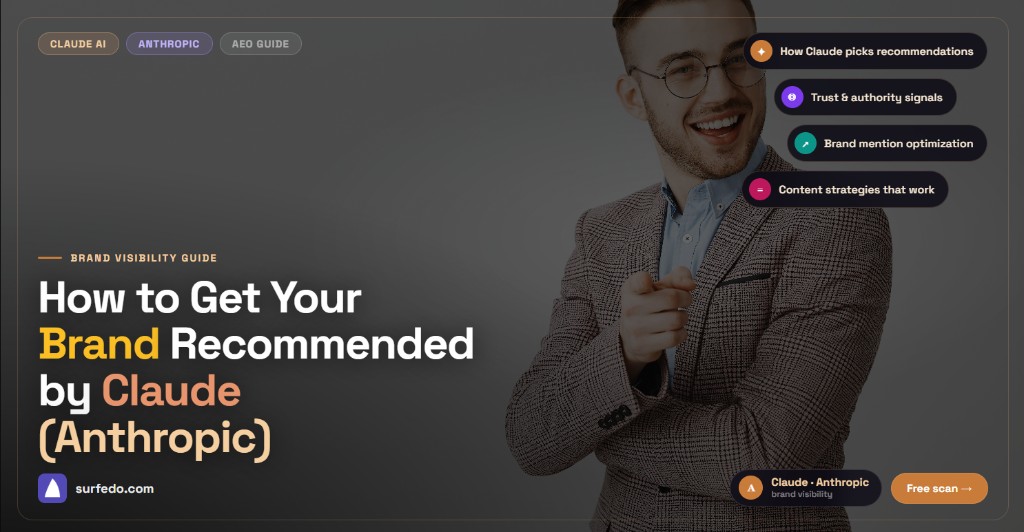
Claude recommends brands based on: authoritative training data (third-party coverage, analyst mentions, review sites), clear entity signals (consistent brand descriptions across the web), well-structured content (FAQs, clear product descriptions, comparison content), and direct AI-readable files (llms.txt). Unlike other engines, Claude is particularly used for expert and procurement queries — meaning getting cited by Claude often correlates with high-intent buyers. Allow ClaudeBot in your robots.txt, then track your exact Claude position ranking weekly.
Why Claude matters for B2B brands
Claude is Anthropic's AI — and while it has a smaller user base than ChatGPT, the users who prefer Claude tend to skew heavily professional: developers, consultants, researchers, and business buyers. These are exactly the people making B2B software purchasing decisions.
Claude is increasingly embedded in enterprise workflows: Claude for Work, Claude.ai business plans, and the Claude API powering internal tools at Fortune 500 companies. When an enterprise buyer uses their company's AI-powered research tool, there's a meaningful chance it's running on Claude. A brand that's invisible on Claude is invisible in a significant portion of high-value B2B research sessions.
There's also a competitive opportunity. Most brands optimising for AI visibility are focused on ChatGPT and Perplexity — Claude is under-optimised. The gap between where brands rank on Google and where they rank on Claude is often larger than for other engines, which means there's more first-mover advantage available. Notably, some tools for tracking Claude visibility require enterprise-tier pricing — Surfedo tracks Claude on all plans from $79/month.
How Claude decides which brands to recommend
Unlike Perplexity, which does heavy live web retrieval, Claude's recommendations are primarily shaped by its training data — the vast corpus of web content Anthropic trained it on — supplemented by retrieval when web search is enabled. This means your brand's visibility in Claude is determined by:
- Quality of training-time coverage: How well was your brand represented in the web content Anthropic used? Third-party reviews, press coverage, analyst mentions, and forum discussions (including Reddit, G2, Capterra) are the raw material for Claude's brand understanding.
- Clarity of entity definition: Can Claude confidently describe what your brand does in one sentence? Brands with consistent, clear descriptions across their website, LinkedIn, G2, Crunchbase, and review platforms train Claude to have a coherent model of the entity.
- Structural content signals: Well-structured content — FAQ pages, comparison tables, clear product descriptions — is easier for Claude to parse and reference than dense or jargon-heavy prose.
- Direct AI guidance files: Claude reads llms.txt files. A well-written llms.txt gives Claude an explicit, curated description of your brand that supplements its training-data understanding.
Tactic 1: Allow ClaudeBot in your robots.txt
This is the floor, not the ceiling. Anthropic's web crawler — ClaudeBot (user-agent: anthropic-ai) — needs access to your site to inform Claude's real-time retrieval and future training updates. Many brands have blocked it inadvertently through catch-all disallow rules.
Check your robots.txt for any rules that disallow anthropic-ai or block crawlers that aren't explicitly whitelisted. Add:
User-agent: anthropic-ai
Allow: /
Beyond robots.txt, ensure your most important pages aren't hidden behind JavaScript rendering that blocks crawlers, login walls, or cookie consent popups that prevent access to page content. ClaudeBot needs to read your pages to understand your brand.
Tactic 2: Create and optimise your llms.txt file
llms.txt is a plain-text file at your domain root (yourdomain.com/llms.txt) that gives AI models a curated, structured description of your brand, product, and content. Claude reads this file during retrieval — and it's one of the highest-leverage interventions you can make for Claude visibility specifically.
A well-structured llms.txt for Claude visibility includes: a one-sentence product definition, your key differentiators as bullet points, pricing (specific numbers, not just "contact us"), your target audience, how you compare to key alternatives, and a list of your canonical URLs with brief descriptions of what each page covers.
The goal is to give Claude the exact information it would need to confidently recommend you in a buyer query. If a buyer asks Claude "what are the best tools for tracking AI search rankings?" — your llms.txt should contain language that maps directly to that question. Full guide: llms.txt: What It Is and How to Create One →
Tactic 3: Build the entity signals Claude trusts
Claude's model of your brand is built from the web content it was trained on — primarily third-party, authoritative sources. To improve Claude's understanding of your brand, you need to build the right external signals:
- G2 and Capterra profiles: These are heavily indexed and Claude draws from them when building brand understanding for software categories. Ensure your profiles are complete, accurate, and have recent reviews. The number and recency of reviews directly correlates with how confidently Claude can recommend you in competitive queries.
- Wikidata entry: Even for brands without a Wikipedia article, a Wikidata entry establishes your brand as a confirmed entity. Include category, founding date, key products, and website URL. This is one of the clearest signals that you're a real, established brand rather than an unknown newcomer.
- Press and analyst coverage: Third-party articles that accurately describe what you do — from SaaS review blogs, industry newsletters, or analyst sites — contribute to Claude's training data representation. A brand mentioned once on its own site is less understood than a brand mentioned accurately in 50 external sources.
- Consistent brand description: Ensure the one-sentence description of what you do is identical (or near-identical) across your homepage, LinkedIn, G2, Crunchbase, AngelList, and any other indexed profiles. Consistency reinforces entity authority — Claude becomes more confident in its understanding of you.
Tactic 4: Structure your content for Claude's reading style
Claude processes and synthesises content differently from a human reader. The content types it most reliably cites and references:
- FAQ pages with direct answers: A question-answer format gives Claude pre-structured information it can directly incorporate into responses. FAQ pages that answer "what is X", "how does X work", "who is X for", and "how much does X cost" are Claude's preferred citation format.
- Comparison pages: Claude frequently answers comparative queries ("X vs Y", "best tools for Z"). Pages that explicitly compare your product to alternatives — with clear feature tables and honest trade-offs — are highly citable. See the pattern at Surfedo vs Cognizo →
- Use-case pages: "AEO for SaaS", "AI visibility for agencies" — pages that define who your product is for in explicit, audience-specific language help Claude match your brand to buyer queries that include audience context.
- Pricing pages with specific numbers: Claude users frequently ask about pricing. Pages that include concrete pricing information (not "contact us for pricing") are significantly more citable in product recommendation queries.
Tactic 5: Deploy FAQPage schema on your key pages
FAQPage JSON-LD schema structured into your site helps Claude (and other AI engines) find and process your content accurately. While Claude primarily runs on training data, its retrieval augmentation layer does read structured data — and future model updates will incorporate your schema-enriched pages.
Deploy FAQPage schema on: your homepage (product FAQs), your pricing page (pricing questions), your blog posts (post-specific FAQs), and your comparison pages (competitive FAQs). Each FAQ block is a discrete, citable unit of information. A page with 8 well-written FAQ blocks gives Claude 8 potential citation anchors per page, not one. Full guide: FAQ Schema for AEO →
Tactic 6: Optimise for Claude's "expert query" use case
Claude's user base skews toward professional, research-oriented queries. This means Claude is more likely to be asked nuanced questions like "what are the best AI visibility platforms for a Series A SaaS company?" rather than "best AI rank tracker" — the kind of high-context buyer query that needs a thoughtful, detailed answer.
Optimise for this by publishing content that demonstrates genuine expertise rather than surface-level coverage. Long-form guides with specific recommendations, comparison pages with honest trade-offs, and data-driven posts that include real numbers and case examples are the content types that score well on Claude's authority model. Thin, generic content rarely makes it into Claude's recommendations for expert queries — even if it ranks on Google.
Measuring your Claude visibility
Claude's responses vary by session and context — you cannot manually track your Claude position reliably. The right approach is automated, consistent tracking: run a fixed query set against Claude's API on a regular schedule and record your exact position per query. Without this, you're optimising blind.
Surfedo tracks your exact position rankings on Claude (alongside ChatGPT, Perplexity, and Gemini) — returning #1, #2, #3 per query per engine with weekly history and trend charts. Claude tracking is included on all Surfedo plans, including the $79/month Pro tier. Run a free scan to see your current Claude position across your key category queries.
Worth noting: some competing tools (like Cognizo) only include Claude tracking at Enterprise pricing. If Claude visibility is a priority — especially for B2B SaaS brands with professional buyer audiences — plan for a tool that includes it at the entry tier.
Free scan across Claude, ChatGPT, Perplexity, and Gemini. Exact position rankings per query. sign up with your email — no card needed for the scan.