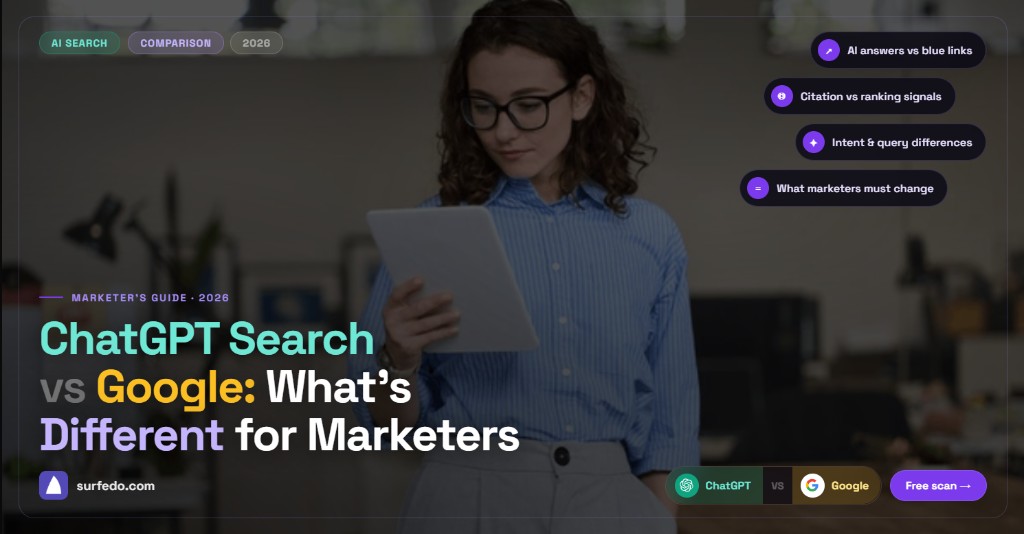
ChatGPT Search vs Google:
What's Different for Marketers in 2026
ChatGPT Search and Google are both "search" — but they work completely differently, reward different content signals, and reach buyers at different moments. Here's what changed and what it means for your marketing.
Google ranks pages. ChatGPT recommends answers. In Google, position 1 gets ~28% of clicks. In ChatGPT, the first recommendation gets considered by ~90% of users — with no second page. The signals that move your Google ranking (backlinks, keyword density) don't directly translate to ChatGPT recommendations. You need both strategies running simultaneously, but they require different content and different technical optimizations.
The shift buyers made — and when it happened
In 2023, asking AI for software recommendations was novel. In 2026, it's the default for a large and growing segment of B2B buyers. The transition was faster than almost anyone predicted: Adobe's Commerce data showed AI-referral traffic growing 12x in the 8 months to February 2025. Semrush reports that LLM-referred visitors convert at 4.4x the rate of organic search visitors.
What this means practically: your buyers are now making shortlisting decisions before they ever visit your website. When a Head of Marketing asks ChatGPT "best marketing attribution tool for mid-market SaaS," they're getting a ranked list — not ten blue links. If your brand isn't in that list, you're not on their shortlist.
How Google and ChatGPT Search work — the core difference
Google is a document retrieval system. It indexes pages, scores them by relevance and authority signals, and returns a ranked list of URLs. The user does the work of reading, evaluating, and synthesising across multiple sources.
ChatGPT Search is a synthesis system. It retrieves from the web, reads multiple sources, synthesises an answer, and presents a recommendation. The AI does the work — and the user gets a conclusion, not a list of sources to evaluate. This fundamental difference has profound implications for what it means to "rank."
| Dimension | Google Search | ChatGPT Search |
|---|---|---|
| Output format | Ranked list of links | Synthesised prose answer with citations |
| User action | Clicks through, evaluates sources | Reads recommendation, may not click at all |
| Primary ranking signal | Backlinks + on-page SEO | Entity authority + structured content + citations |
| Content format rewarded | Comprehensive, keyword-optimised | Direct answers, structured, extractable claims |
| Freshness importance | Moderate | High (especially for live-retrieval engines) |
| Brand trust signal | Domain authority (backlinks) | Entity knowledge (Wikidata, reviews, press) |
| Competitor visibility | Can coexist on same results page | Zero-sum: 2–3 brands recommended, rest invisible |
| Traffic model | Click-through to website | Zero-click answers common; referral when cited |
What stays the same across both
Before diving into the differences, it's worth noting what works in both systems — because your existing SEO investments aren't wasted, they just need augmentation:
- Content quality: Both systems reward comprehensive, well-structured, authoritative content. There's no low-quality content shortcut on either platform.
- Domain authority: High-DA domains rank better in Google and get cited more in ChatGPT. The correlation isn't perfect, but it's positive.
- Topic expertise: Both systems favour brands that consistently publish on a focused set of topics over those with scattered content.
- Technical health: Fast, crawlable, well-structured pages perform better in both systems.
What changes — and requires specific AEO work
Backlinks don't translate directly. A brand with 10,000 referring domains gets a Google ranking boost that doesn't automatically translate to ChatGPT citations. ChatGPT weights entity signals (Wikidata, review platforms, knowledge graph data) more heavily than traditional link authority. A brand with 100 referring domains but strong Wikidata presence, 50 G2 reviews, and consistent entity descriptions can outrank a brand with 10x the backlinks in ChatGPT responses.
Keywords become queries. Google keyword optimization targets specific search terms. ChatGPT optimization targets the intent behind a query — and because ChatGPT synthesises across sources, there's no single page to "rank." Instead, your entire brand's web presence contributes to the recommendation. The goal shifts from ranking a specific page to building overall brand authority in a category.
Structure over prose. Google rewards comprehensive, well-written long-form content. ChatGPT rewards extractable, citable claims. The same piece of content needs to work differently: lead with the direct answer, use structured formats (tables, numbered lists, FAQ sections), write every paragraph as if it might be quoted in isolation. FAQ schema markup is a direct feed into ChatGPT's Q&A-format responses.
Third-party citations over self-promotion. Google can be influenced heavily by your own site. ChatGPT is influenced heavily by what others say about you. G2 reviews, Reddit discussions, press mentions, analyst coverage, podcast transcripts — these off-site signals carry weight in ChatGPT that your own website content cannot fully replace.
Running both strategies simultaneously
The right answer isn't to choose between Google SEO and AEO — it's to run both. The good news is they share a significant amount of infrastructure: quality content, technical health, fast pages, and domain authority benefit both systems.
The additional AEO-specific work is: entity setup (Wikidata, consistent brand description, schema), AI crawler access (robots.txt, llms.txt), review platform investment (G2, Capterra), and content restructuring for extraction (FAQ schema, direct-answer format). None of this conflicts with SEO — it's additive.
Think of it as a two-layer strategy: the SEO layer captures buyers who still start with Google. The AEO layer captures the fast-growing segment that starts with ChatGPT or Perplexity. Missing either layer means missing a meaningful slice of your addressable market.
How to measure both simultaneously
For Google: Google Search Console tracks impressions, clicks, and average position by query. This is your baseline for SEO performance.
For AI search: you need a tool that queries ChatGPT (and ideally Perplexity, Gemini, and Claude) with your target prompts and records your exact position per query. This is what Surfedo does — giving you the AI-search equivalent of Search Console, so you can see both where you rank now and how your position changes as you implement fixes.
Surfedo shows your exact position per query across ChatGPT, Perplexity, Gemini, Claude, and Google AI Overviews. Free scan in about 2 minutes.