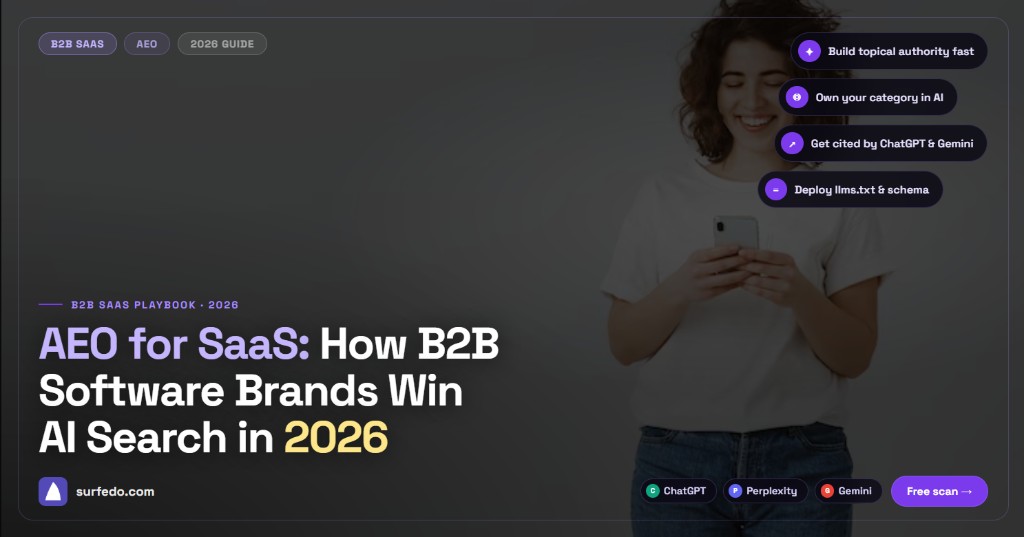
AEO for SaaS: How B2B Software Brands
Win AI Search Recommendations in 2026
B2B buyers are asking ChatGPT, Perplexity, and Claude to recommend software before they ever visit your website. Here's the complete AEO strategy for SaaS brands — from entity foundation to content signals to off-site presence.
AEO for SaaS means getting your product recommended when buyers ask AI engines "best [category] for [use case]." The five foundations: entity authority (Wikidata + consistent brand description), technical access (robots.txt + llms.txt + schema), review platform presence (G2 is non-negotiable), query-targeted blog content, and competitor comparison pages. SaaS brands that do all five see AI recommendation rates 3–5x higher than those that don't.
Why AEO matters more for SaaS than any other category
B2B software buying has always been research-intensive. In 2026, that research starts with AI. A VP of Marketing evaluating project management tools doesn't Google "best project management software for agencies" and click through ten links. They ask ChatGPT. They ask Perplexity. They use the ranked answer as their shortlist.
The commercial stakes are uniquely high for SaaS because: the average B2B SaaS deal value means missing one recommendation cycle costs tens of thousands in pipeline. Buyers are evaluating category-level queries ("best CRM for SaaS"), use-case queries ("project management tool for remote agencies"), and comparison queries ("Asana vs Monday vs ClickUp") — all of which AI engines now answer authoritatively.
For SaaS specifically, G2 and Capterra are disproportionately influential citation sources. AI engines treat them as trusted third-party validators for software recommendations in a way they don't for most other categories. This makes the SaaS review ecosystem a direct AEO lever.
How B2B buyers use AI in the purchase journey
Understanding where AI fits in the SaaS buying journey tells you exactly what content to create and optimize. There are three distinct AI-search moments in a typical B2B evaluation:
| Journey stage | Typical AI query | Content that gets cited |
|---|---|---|
| Category awareness | "What tools help with [problem]?" | Pillar guides, definitional content, category explainers |
| Vendor shortlisting | "Best [category] for [use case]" | G2 listings, comparison pages, use-case blog posts |
| Final evaluation | "[Brand A] vs [Brand B]" | Dedicated /vs/ comparison pages, review platform profiles |
Most SaaS AEO programs focus only on the shortlisting stage — which is the most competitive. The better strategy is to create content for all three stages and own the full buyer journey in AI search.
Signal 1: Entity authority — the foundation everything else builds on
Before an AI engine recommends your brand, it needs to understand your brand as an entity — not just a website. Entity understanding comes from structured knowledge sources: Wikidata, Crunchbase, LinkedIn, G2, and press mentions in publications with editorial standards.
The single highest-ROI action for any SaaS brand with zero AEO presence: create a Wikidata entry. It's free, has no notability requirement, and creates a permanent entity signal that all major AI engines use to resolve your brand's identity. Add: official website, founding date, industry, headquarters location, and sameAs links to LinkedIn and Twitter.
The second action: write one canonical brand description — 2–3 sentences describing what your product does, for whom, and what makes it different — and publish it identically across your homepage, About page, LinkedIn company description, G2 profile, Crunchbase, and llms.txt file. Consistency across sources is what builds entity confidence. Inconsistency dilutes it.
Signal 2: Technical foundation — make yourself crawlable and machine-readable
Three technical files govern your AEO foundation. All three are free to implement and none require a developer once you know what to write.
robots.txt: Explicitly allow GPTBot, PerplexityBot, ClaudeBot, and GoogleOther. Many SaaS sites have legacy configurations that block all unlisted crawlers. One line per bot. This is a prerequisite for everything else — a blocked crawler can't cite you regardless of how good your content is.
llms.txt: A plain-text file at your domain root (yourdomain.com/llms.txt) that tells AI crawlers your brand description, key pages, pricing, and preferred citation format. Think of it as a sitemap for AI engines. Most SaaS brands haven't created one — the majority of AI citation wins in 2025 came from early adopters of this file.
Schema markup: Add Organization JSON-LD to your homepage (with your Wikidata URL in sameAs), FAQPage JSON-LD to your homepage and pricing page (6–8 Q&As each), and SoftwareApplication JSON-LD to your product pages. These give AI engines structured, unambiguous signals about your brand — signals they can extract and use directly.
Signal 3: Review platform presence — the SaaS-specific multiplier
For B2B SaaS, G2 is the most influential third-party AEO signal. AI engines cite G2 heavily for commercial software queries because it provides structured, human-authored third-party validation at scale. A SaaS brand with 50 G2 reviews that mention specific use cases and outcomes is cited dramatically more often than one with 5 generic reviews.
Priority order for SaaS review platforms: G2 (highest AI citation rate), Capterra (strong for SMB-focused tools), Product Hunt (strong for new/innovative products and founder-audience brands), TrustRadius (enterprise B2B).
When asking customers for reviews, brief them: ask them to include the specific use case, the outcome achieved, the team size, and the alternative they considered. Specific reviews provide more citation signal than generic ones — an AI engine can extract "reduced reporting time by 40% for a 12-person marketing agency using [Brand] instead of Excel" as a concrete claim. "Great tool, highly recommend" is not citable.
Signal 4: Query-targeted blog content
Every blog post should target one specific query your buyers type into AI engines. Not a keyword — a query. "Best project management tool for remote agencies" is a query. "Project management software" is a keyword. AI engines answer queries, not keywords.
Structure every post for AI extraction: question as H1, direct 2-sentence answer immediately after the H1, supporting detail in subsequent paragraphs, comparison table or numbered list where applicable, FAQPage schema on the page. Make every paragraph independently citable — AI engines frequently pull a single paragraph, not an entire article.
For SaaS specifically, these post formats drive the most AI citations: category comparison guides ("best [category] for [use case]"), use case deep dives ("how [category] helps [specific role]"), integration guides ("how [your tool] + [popular tool] workflow"), and migration guides ("switching from [competitor] to [your brand]").
Signal 5: Competitor comparison pages
Dedicated comparison pages (/vs/competitor-name) are the highest-citation content type for evaluation-stage queries. When a buyer asks ChatGPT "Salesforce vs HubSpot vs Pipedrive," the engine cites comparison pages from the brands themselves — because they're the most detailed, structured source of that comparison data.
Write comparison pages factually, not as attack pieces. Include a feature comparison table, an honest verdict on who each tool is best for, and a clear statement of where your product wins and where it doesn't. Pages that acknowledge limitations build trust — and trust is a signal AI engines respond to in the form of citation frequency.
The SaaS AEO launch checklist
| Priority | Action | Time |
|---|---|---|
| 🔴 P0 | Create Wikidata entry | 1 hour |
| 🔴 P0 | Fix robots.txt — allow all 4 AI crawlers | 10 min |
| 🔴 P0 | Create llms.txt at domain root | 1 hour |
| 🔴 P0 | Add Organization + FAQPage schema to homepage | 2 hours |
| 🟡 P1 | Get listed and reviewed on G2 (target 15+ reviews) | 1–2 weeks |
| 🟡 P1 | Add FAQPage schema to pricing page | 1 hour |
| 🟡 P1 | Publish 3 query-targeted blog posts | 1 week |
| 🟡 P1 | Create /vs/ pages for top 3 competitors | 1 week |
| 🟢 P2 | Run baseline AI visibility scan and record positions | 1 hour |
| 🟢 P2 | Participate in 3 relevant subreddits | Ongoing |
Surfedo's 40-point AI audit shows exactly which AEO signals you're missing and prioritizes what to fix first. Free scan in about 2 minutes.